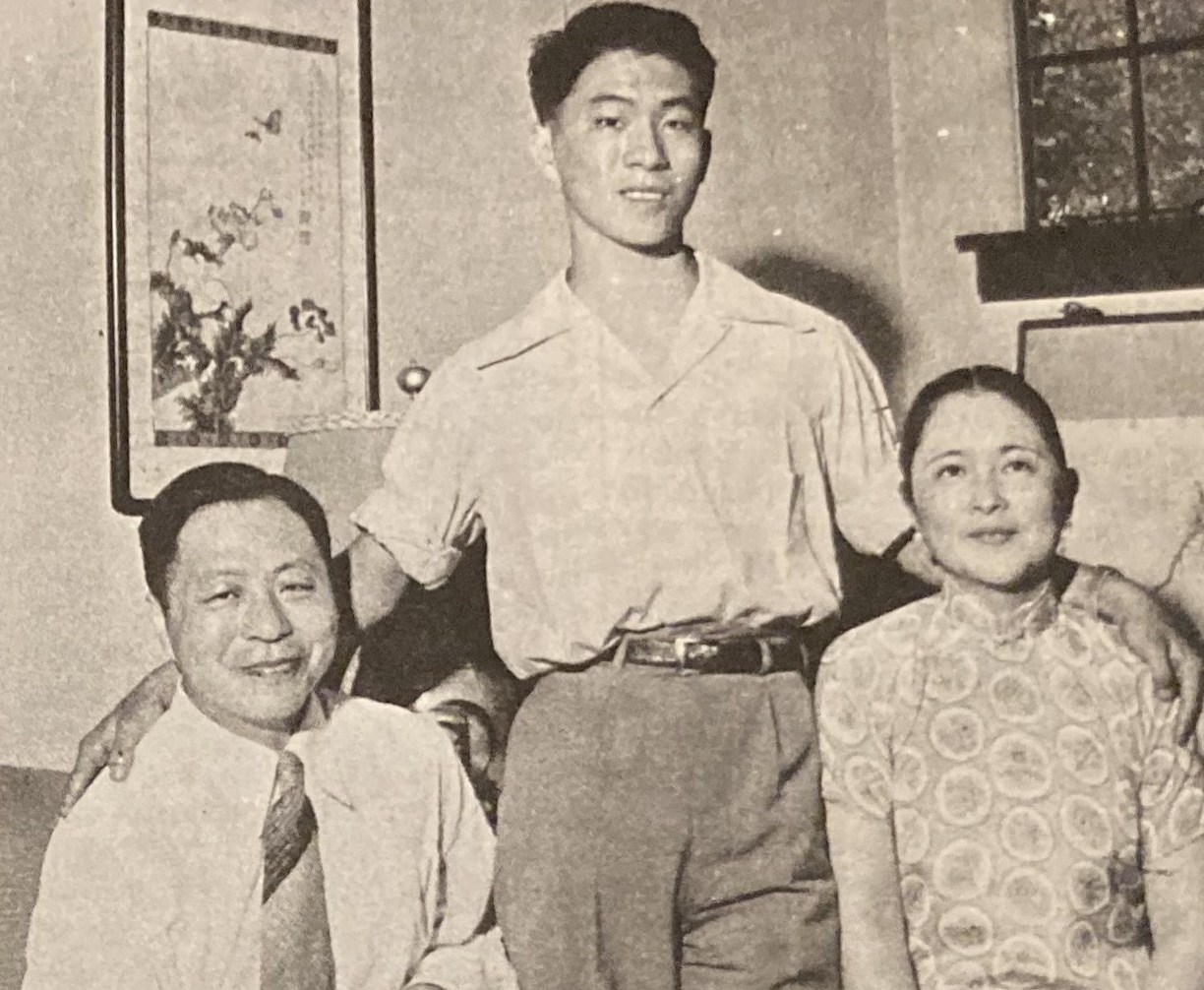
K.C. Wu and Family in Evanston
In the 1950s and 1960s, Evanston was the home of a high profile Chinese family with an intriguing history. Kuo-chen Wu (1903-1984) arrived in Evanston in 1953 with his wife Hsiu-hwei, known as Edith. K. C., as he was known here, had served with Chiang Kai-Shek and held a number of high profile positions in the Chinese Nationalist Party. When the party had fled to Taiwan after the Communist takeover of mainland China, Wu served as governor of the island. He disagreed with Chiang Kai-Shek’s shift toward authoritarian rule, was the target of an assassination attempt, and immigrated to the United States. Three of their children were already here. Daughter Hsiu-yung (Eileen) was attending Washington University, daughter Hsiu-Hwei, also known as Edith, was attending Northwestern University, and son Jueo-chen (Hugo) was attending Lawrenceville Academy in New Jersey. The youngest son, Hsiu-huang, remained in Taiwan with relatives. The family fought to get him a passport, but it was delayed for a year, to keep K. C. from speaking out against the government. The passport was finally issued in the summer of 1954 and Hsiu-huang joined the family in Evanston. Pictured above are K.C., Hsiu-Hwei, and Edith, photo courtesy of Evanston Photographic Services.
In China and Taiwan
K. C. Wu was born in Jianshi County, Hubei and grew up in Beijing, where his father served in the miliary. K. C. attended Tianjin Nankai High School and was a classmate of Zhou Enlai. He first studied at Tsinghua University, then came to the United States and earned a Bachelor’s Degree in Economics from Grinnell College in Iowa in 1923. He then attended Princeton University, earning a master’s degree and a Ph. D. in Political Science. After graduating in 1926, he returned to China and worked as a tax collector in Hankou. In 1931, he married Edith, a gifted artist, and the couple had four children: Hsiu-Hung, born in 1931, Hsiu-hwei, born in 1933, Jueo-chen born in 1935 and Hsiu- huang, born in 1937.
K.C. Chen’s success in balancing the books in Hankou prompted Chiang Kai-Shek to appoint him mayor, beginning in 1932. When Hankou fell to Japanese forces in 1938 during the Second Sino-Japanese War, the family fled to Chonqing. He was again appointed mayor of that city and served until 1942. During World War II he was Vice Minister of Foreign Affairs, 1943-1945. After the war he was appointed Minister of Information from 1945-1946. In 1946 he was appointed the mayor of Shanghai. China was grappling with the aftermath of years of war, and Shanghai was in turmoil. Life Magazine ran an extensive story and photo essay of Wu at work as mayor and with his family in the July 21, 1947 issue. The article was entitled, “The Worst Job in the World.”
Chinese communists took over the country in 1948 and supporters of the republic fled to Taiwan, then known as Formosa. Chiang Kai-Shek appointed Wu governor of the island, where he was responsible for instituting free elections, land reform, and instituting a western judicial system. He was featured on the cover of Time Magazine’s August 7, 1950 issue, with a lengthy story highlighting Wu’s leadership and the role of Taiwan in holding back communist influence particularly in relation to the emerging war in Korea.
As time went on, Wu and Chiang Kai-Shek found their ideological paths diverging and Wu spoke out against the increasingly authoritarian nature of the republic. After an attempt on his life, he and Edith fled to the United States. His friendship with Col. Robert McCormick of the Chicago Tribune, who had met him on a visit to China in 1948, may have helped facilitate the process. Both daughters entered Northwestern University in 1950, “under the watchful eye” of McCormick. Eileen was married to Dr. Yu, whom she met at Northwestern, at McCormick’s home at Cantigny in 1952, with the Col. standing in for her father, who was still in Taiwan. The wedding was covered in the society pages of the Chicago Tribune. She went on to attend Washington University with her husband who had taken a teaching position there. The following June, Edith was a debutante at the Chicago Cotillion, under McCormick sponsorship. According to the Tribune, it was “the first time in Chicago history that a young woman of the far east has bowed formally to society here.”
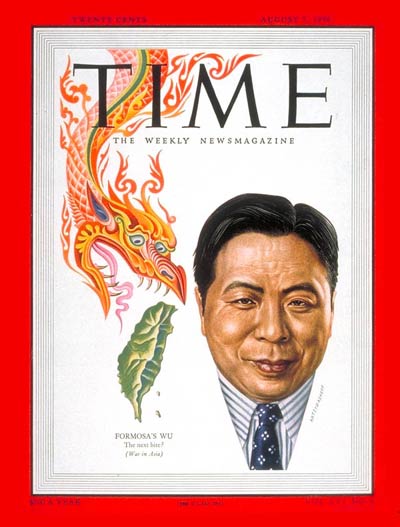
TIME. August 7, 1950. Photo: Boris Artzybasheff
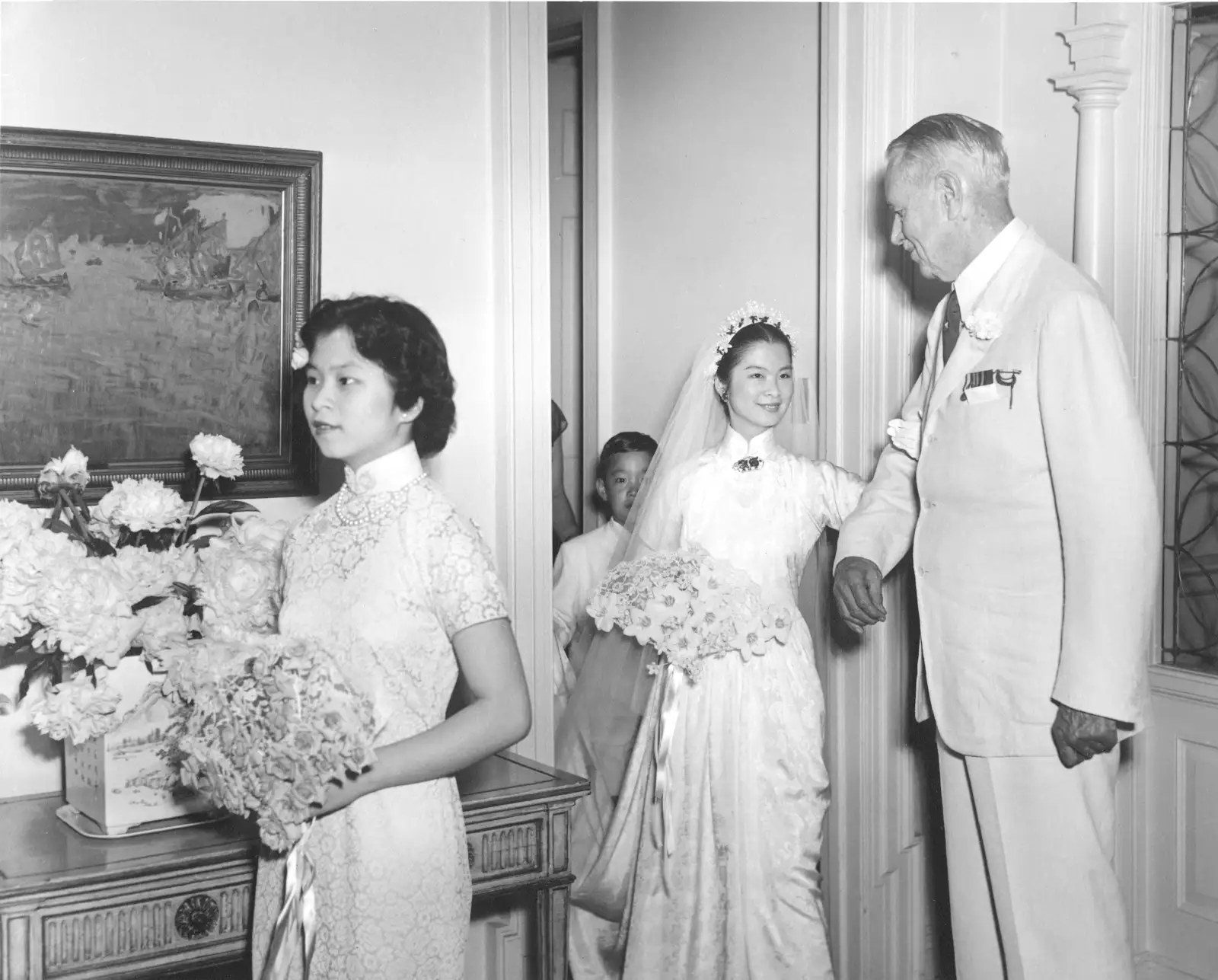
Wu wedding, 1952. Courtesy of the McCormick Foundation
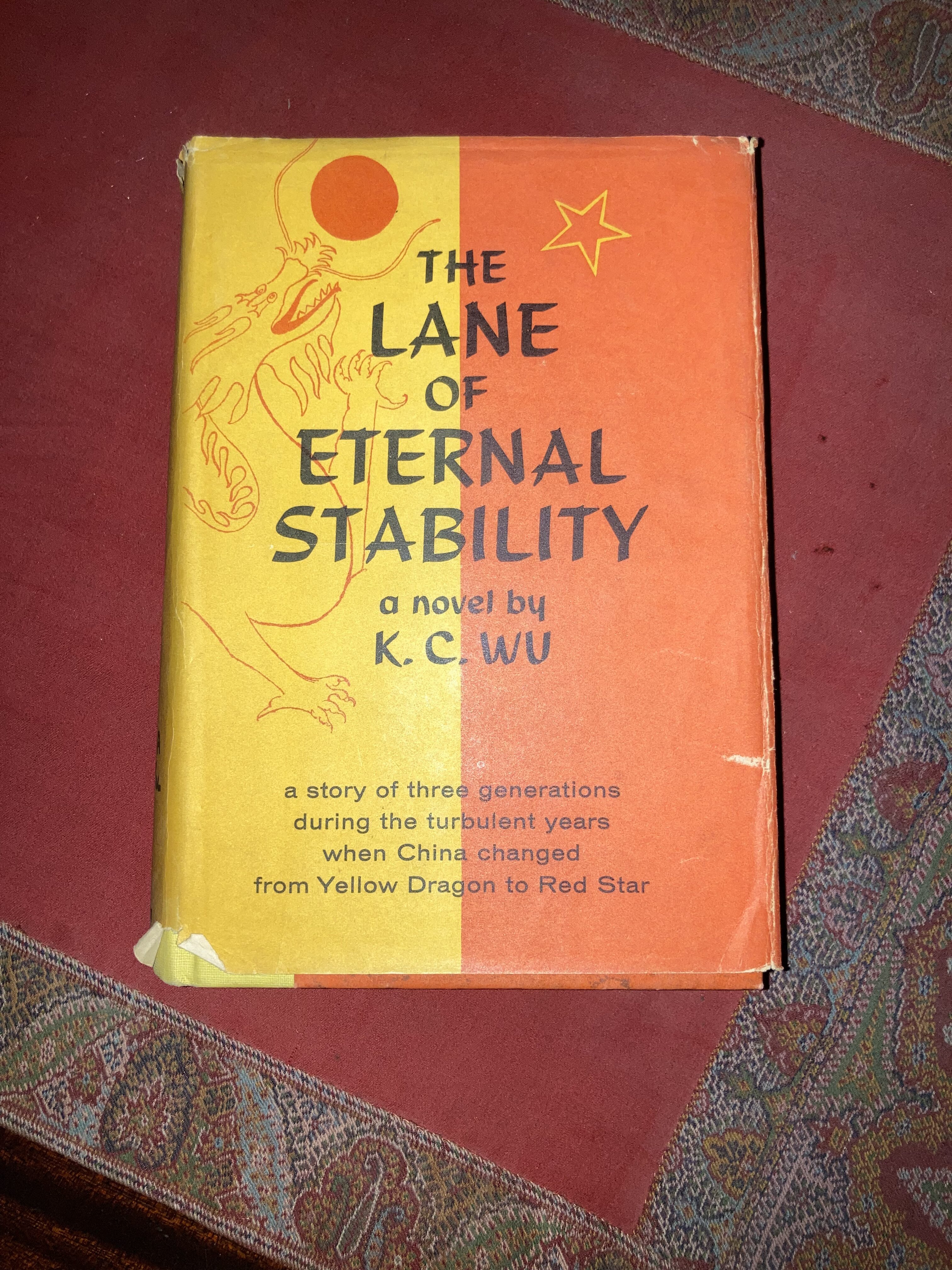
Wu’s 1962 novel. Courtesy of the Evanston History Center.
In Evanston
When K. C. and Edith Wu first arrived in Evanston, they lived in a two-room apartment in The Georgian, a residence hotel on Davis Street that is now part of The Mather. The Chinese press sought to discredit him, saying he had absconded with funds and was living a luxurious life in the US. They also refused to issue a passport for the youngest child, Hsiu- huang, who remained in Taiwan with Edith’s sister. This was likely to maintain control of K. C. and Edith and try to persuade them not to speak out against the government and to return to Taiwan. K. C. earned a living through an intensive schedule of speaking engagements around the area and the country. Edith painted, exhibited, and sold her beautiful artwork.
The Wu’s rented a house at 1315 Wesley for a few months until they were able to purchase 1113 Grant Street in 1954. Their son was finally granted a passport and arrived in Evanston that summer, reuniting the family at last. The Evanston Review was full of stories about K. C.’s lectures and Edith’s art exhibits. One story noted that her painting, 1,000 Chrysanthemums, sold for $10,000. K. C. Wu brushed on the calligraphic poetry that was intrinsic to the art. Hsiu-huang began attending ETHS as a junior that fall. He chose the Anglicized name of Sherman, in part because it sounded similar to his Chinese name, and, according to his obituary, inspired by Evanston’s Sherman Avenue. He joined Junior Achievement and was an advisor to his senior prom, which chose a Chinese myth as a theme that year, Dancing in Moonlight, based on a Chinese folklore story he shared.
Sherman Wu entered Northwestern University in the fall of 1956. He participated in rush and was accepted as a pledge to Psi Upsilon fraternity. Some members of the fraternity objected to his joining, saying that his ethnicity would compromise the status of the fraternity. A column in the Daily Northwestern wrote about the “depledging” without naming Wu or the fraternity. The author stated the exclusion showed “prejudice and hypocrisy” and signaled the decline of the fraternity system. Wu wrote a response to the paper, stating that he was the unnamed pledge. He said he supported the system, aside from “a few peoples’ ignorance and prejudice” and he had made “quite a number of friends, and we’ll still be friends truthfully and loyally, not only in school years, but through our entire lives.” The story was picked up in papers across the country and received nationwide publicity. A 2023 article in the Sun Times quoted Sherman Wu, “First there was only hatred in my mind,” he wrote, “But after the newspapers and magazines publicized the incident, I received more than 300 letters from all over the United States saying they wanted me to know what a real American felt about this.”
In 1958, folk musician Pete Seeger wrote a song entitled “The Ballad of Sherman Wu.” Using the tune “The Streets of Loredo”,” the lyrics described the fraternity’s racial exclusion. The song was released and Seeger performed it on tour. Sherman Wu went on to get his Ph.D. in electrical engineering from Northwestern. He then held professorships at several US universities, with 27 years at Marquette University. He also had an illustrious career as a consultant that included designing guidance control systems used in airplanes and spacecraft, including NASA’s Apollo missions. He died in 2010, a decade after the fraternity chapter at NU was closed “for multiple risk management violations and lack of standards.”
In 1962, K. C. Wu published his epic novel, “The Lane of Eternal Stability.” He used a fictional story of three generations of a Chinese family as they navigated the sweeping changes in mid-20 th century China as it transitioned from dynastic rule, through wars and democracy, to the communist takeover. Wu’s purpose was to educate Western readers, saying, “there are so many things people in the West don’t understand about China.”
After more than ten years living in the house on Grant Street, Wu accepted a professorship at Armstrong College and he and wife Edith moved to Savannah, Georgia. K. C. died in 1984, and Edith in 2002.
By Kris Hartzell, Director of Facilities, Visitor Services and Collections, The Evanston History Center
